






























The epic Mahabharata probes deeply into the concept of dharma, discovering its various facets and how it applies to different situations in our lives. The epic serves as a practical guide to the philosophical and spiritual truths found in the Vedas. The Mahabharata is estimated to be over 5,200 years old It uses stories, characters, and events of Kurukhetra war between Kauravas and Pandavas to make these teachings more understandable and relevant to people’s lives.
Veda Vyasa wrote the Mahabharata primarily to preserve and disseminate knowledge, particularly about dharma (righteous conduct) and the complexities of human life. He believed the epic would be beneficial for humanity, offering guidance on principled behaviour, and exploring the consequences of actions. He also wanted to illustrate the teachings of the Vedas in a more relatable and accessible narrative. Ved Vyasa wanted to showcase the complexities of human characters, the right and the wrong conduct, the consequences of actions, and the challenges of living a virtuous life, especially in times of conflict and adversity. As per the puranas, Vyasa was instructed by Lord Brahma to write the Mahabharata, because Vyasa had witnessed the war of Kauravas and Pandavas and Brahma knew that Vyasa would do justice writing the epic without any ambiguity so that entire story could be a teaching for the future generations. Brahma knew Vyasa would convey its meaning.
The Mahabharata was composed in a cave called Vyas Gufa, located in the village of Mana, near Badrinath in the Himalayas.
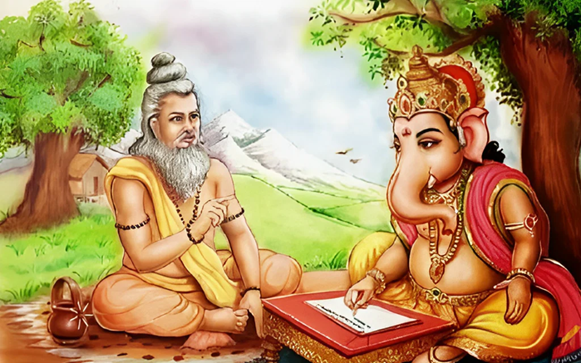
Ved Vyasa chose Ganesha to write the Mahabharata because he needed a scribe (write) who could keep up with his rapid narration and ensure the epic’s profound meaning was fully grasped. Ganesha, known for his sharp intellect and ability to understand complex concepts, was the perfect choice. Additionally, Ganesha’s role as the remover of obstacles and the God of new beginnings made him most fitting divine scribe for such a massive work. Lord Ganesha’s elephant head signifies wisdom and intelligence.
Ganesha laid a condition that Vyasa must recite the epic without pause. Vyasa, in turn, proposed his own condition; Ganesha must not write anything without first understanding the meaning of what he dictates. This agreement allowed the monumental task of recording the Mahabharata to begin, with Vyasa occasionally using complex verses to create pauses for rest and preparation, knowing Ganesha would need time to grasp their meaning before writing them down. During the flow of writing, as Vyasa dictated, Ganesha’s writing tool a quill broke, and Ganesha, rather than interrupting the flow, broke off his tusk to use as a pen. This act of sacrifice and commitment is why Ganesha is also known as Ekadanta, meaning “one-tusked”.
Divine Collaboration: This collaboration between Vyasa and Ganesha highlights the divine nature of the Mahabharata and the involvement of both human and divine forces in its creation. This collaboration highlights the power of teamwork, the blending of intellect and devotion, and the dedication required to preserve wisdom and knowledge. The Mahabharata, as a result, became a testament to the power of collaboration between a wise sage and a divine scribe.
The Mahabharata remains relevant even today due to its timeless exploration of human nature, ethics, and the complexities of life, offering insights applicable to personal, social, and political spheres. Its characters, though flawed, are relatable, and the epic’s narratives provide frameworks for understanding conflict resolution, leadership, and the consequences of actions. The epic covers the complexities of human nature, relationships, and the struggle between good and evil. It portrays humans as inherently flawed, capable of both great virtue and profound wickedness. It portrays characters who are neither purely good nor purely evil, highlighting the complexities of human morality. Characters like Arjuna struggle with internal conflicts, while others like Duryodhana exhibit both positive and negative traits. Karna, a tragic hero of the Mahabharata, struggled between loyalty and righteousness. Though noble and generous, he sided with Duryodhan for the sake of friendship and gratitude.

