








































The SPACE Matrix, which stands for Strategic Position and Action Evaluation Matrix, was introduced by researchers Alan Rowe, Richard Mason, Karl Dickel, Richard Mann, and Robert Mockler. Companies like Nestlé, WGS, BCG, Gartner, L’Oreal, Beta Lab, Legato, Amex, Taikoo, Avendus have reportedly utilized the Space Matrix for strategic planning and workplace design,
SPACE Matrix is a management tool that is used to analyse an organization based on four dimensions, two internal and two external. To define an appropriate strategy for that organization, the dimensions of the SPACE matrix that can be included are as: Financial Strength (FS) this is an internal dimension which can include return on investment, leverage, liquidity, capital, risk involved in business etc. as key factors. second is Competitive Advantage (CA): this is also an internal dimension which includes market share, product quality, product life cycles etc. The external factors are industry strength (IS) which includes growth and profit potential, financial stability, technological know-how etc. the fourth factor is environmental stability (ES) which includes technological change, rate of inflation, demand variability, price fluctuations in raw material etc. as key factors.
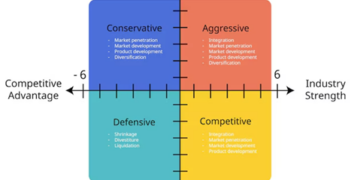
The space matrix works like this: the key factors under each dimension are evaluated by the decision maker(s) of the organization and a score between 0 and -6 is assigned to each one of them belonging to FS (financial strength) and IS (industry strength). The arithmetic mean for each dimension is calculated. CA and IS values which are plotted on the x axis and FS and ES on the y axis, both being key factors used to assess a company’s strategic position within its market by plotting them on a graph, with FS on the Y-axis and ES on the negative side of the Y-axis; essentially indicating how strong a company’s financial standing is compared to the stability of its external environment. The sum of CA and IS (resp. FS and ES) values will give the final x (resp. y) value of the organization’s suggested strategy type. Once the above steps are executed, the appropriate strategy can be found in either one of the following four strategic locations which can be seen in Fig. given in the beginning of the passage. Aggressive posture, Competitive posture, Conservative posture and Defensive posture.
Aggressive Posture
This posture indicates that the company can fully exploit available opportunities and enhance its market share. As the company has high financial strength, high industry strength, it enjoys competitive advantage and belongs to an attractive industry and operates in a relatively stable environmental condition. This posture is related to Michael Porter’s cost leadership strategy among the generic strategies. A cost leadership strategy is a business plan to become the lowest-cost producer in an industry. This strategy helps companies offer lower prices than competitors, which can attract more customers.
Competitive Posture
This posture indicates limited financial strength, medium competitive advantage in an attractive industry and operating in a relatively volatile or unstable environment, requiring the company to maintain and enhance competitive advantage by improving or differentiating product, spreading the product line, improving marketing effectiveness and mobilizing, augmenting financial resources. This posture is considered to be quite like product differentiation strategy of Michael Porter. This is a business approach that involves making a product or service distinct from competitors. The goal is to attract customers and gain a competitive edge.
Conservative Posture
This posture indicates a company having limited competitive advantage, in a not so attractive industry but enjoying financial strength and operating in a relatively stable environment. Such a company should endeavour to cut down non-performing product, control costs, improving productivity, introducing new products and enhance sales by profitable market expansion. This posture can be compared with Porter’s generic strategy called focus or a niche strategy of a business strategy that concentrates a company’s resources on a specific market segment.
Defensive Posture
This posture indicates a company that lacks both competitive advantage and financial strength and belongs to a not-so-attractive industry and operates in an insecure environment. All the four dimensions are weak and works against the company. It is advisable for a such a company to initiate measures like discontinue nonviable (non-capable) products, tightly control cost and monitor cash flows strictly, cutting down or reducing capacity and postponing or limiting investments. This strategy is compared to Porter’s stuck in middle strategy. “Stuck in the middle” in a generic strategy refers to a situation where a company fails to clearly commit to any one of the three primary competitive strategies (cost leadership, differentiation, or focus), leaving them with no distinct advantage and often performing poorly because they are neither the cheapest nor the most differentiated in the market, essentially being caught between different positions without a clear identity to customers; this is a concept primarily attributed to Michael Porter’s generic strategies framework.
Conclusion
The basic strategic postures determine the appropriate financials as regards the project related investment. After identifying the appropriate posture of an organisation, which in turn helps to identify the organisation generic competitive strategies. This leads to define the strategic drive for the business. Subsequently the mangers or the top-level management of the organisation can choose the appropriate strategy in which their organisation focuses on needs and goal. Porter’s Generic Strategies identify three core competitive strategies (cost leadership, differentiation, and focus) based on a company’s source of competitive advantage and market scope, whereas the Space Matrix is a broader analysis tool that considers both internal and external factors like market attractiveness and competitive position to determine a company’s overall strategic direction.