






































Agency theory was independently developed by Stephen Ross in economics and Barry Mitnick in institutional management during the mid-1970s. The most cited work, however, is by Michael C. Jensen and William H. Meckling (1976), who formalized the theory by defining agency costs and creating a framework for reducing conflicts of interest between principals (like owners) and agents (like managers).
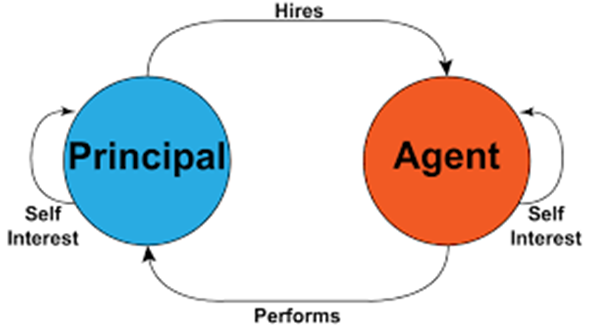
Agency theory explains the relationship between a principal, who delegates authority, and an agent, who acts on the principal’s behalf. In a corporate setting, the principal is typically the employer or shareholder, while the agent is the manager or executive responsible for running the organization. A manager plays a crucial role by acting as a link between the employees and top management. Their primary responsibility is to provide leadership and guidance to a team or department, ensuring organizational goals are met through efficient planning, organizing, staffing, leading, and controlling of work. Key responsibilities of the manager include:
Setting individual employee goals
Setting individual employee goals is a core responsibility of a manager, but it should be a collaborative process. Managers work with employees to align individual goals with the company’s strategy, provide ongoing feedback, and involve them in goal setting to foster engagement and development. This approach ensures that individual targets not only support team and organizational success but also contribute to the employee’s personal and professional growth. By translating company strategy into clear, relevant, and achievable objectives, managers help employees understand their role in the broader mission and drive meaningful performance.
Delegating tasks effectively
Effectively delegating tasks is a core responsibility of a manager, crucial for optimizing time management, fostering employee development, and enhancing overall team efficiency and productivity. Good delegation goes beyond merely assigning work; it involves strategically selecting tasks, aligning them with the strengths and capabilities of the right team members, providing clear instructions and the necessary resources, and fostering an environment of trust. Additionally, it requires holding individuals accountable for their results while maintaining open lines of communication and providing ongoing support to ensure successful outcomes.
Monitoring and evaluating employee performance
Effectively monitoring and evaluating employees is a core responsibility of a manager, essential for setting clear expectations, identifying areas for improvement, and fostering continuous development and engagement within the team. This process involves setting clear goals, defining specific, measurable, achievable, relevant, and time-bound (SMART) objectives that align individual performance with organizational priorities. Continuously observing employees’ work to assess progress, behavior, and adherence to standards in real time. Maintaining accurate records of performance metrics, achievements, challenges, and behaviors to support objective evaluations. Providing continuous feedback and coaching.
Motivating and inspiring the workforce
Effectively motivating and inspiring employees is a key responsibility of a manager, as their ability to foster a positive work environment, provide clear guidance, and recognize achievements directly influences productivity, engagement, and overall organizational success. Managers can accomplish this by understanding individual employee needs, communicating a compelling vision, setting achievable goals, offering meaningful incentives and development opportunities, delivering constructive feedback, and cultivating a culture of trust and collaboration.
Making critical decisions
Making critical decisions is a central role of a manager, as managers are responsible for choosing the best courses of action to resolve issues, achieve organizational goals, and guide teams. This involves a process of identifying problems, gathering information, analysing options, selecting the best solution, implementing it, and reflecting on the outcome to ensure company growth, effective operations, and overall success. Managers make countless daily decisions, from assigning tasks to managing budgets, all of which impact the organization. Decisions on new strategies, partners, and resource allocation directly influence the company’s growth and competitiveness.
Acting as a communication bridge between employees and top management
A manager acts as a crucial communication bridge between top-level management and their team of employees, ensuring that strategies from above are translated into actionable plans for the team, and that employee feedback, concerns, and performance data are communicated back up to senior leadership. This role involves clarifying expectations, fostering transparency, advocating for team needs, and ensuring smooth communication flow to maintain understanding and alignment within the organization. Managers interpret higher-level business goals and strategies from senior management, transforming them into clear, achievable operating plans and tasks for their employees. They communicate company policies, objectives, and changes to their team, making sure that employees understand the bigger picture and their role within it.
The principal-agent problem
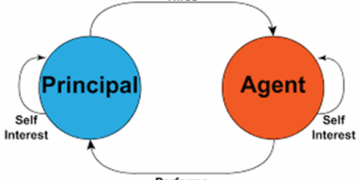
In agency theory, the principal delegates authority to the agent, focusing on the potential conflicts of interest that may arise when the agent pursues their own self-interest instead of the principal’s. This situation is termed the principal-Agent Problem and is especially relevant in corporate governance, where shareholders (principals) rely on company managers (agents) to run the organization. A major issue in this relationship is passing on few wrong points which is called information asymmetry where the agent has more information about daily operations or specialized knowledge than the principal. This imbalance allows the agent to make decisions that the principal may not fully understand or control, sometimes to the detriment of the principal’s goals.
the agent holds more information than the principal, creating an imbalance of power and understanding. The outcome of such conflicts is known as Agency Loss: the reduction in the principal’s welfare due to the agent’s self-serving actions.
Key Concepts of Agency Theory:
Principal: The party that delegates authority and expects certain tasks to be performed on their behalf. Commonly, this is the shareholder or owner of the business.
Agent: The party entrusted to act on behalf of the principal, typically a company manager, whose duty is to make decisions that serve the principal’s best interests.
Principal-Agent Problem: The core conflict where the agent’s personal incentives do not align with the principal’s objectives, leading to potentially harmful decisions.
Information Asymmetry: A situation where the agent holds more information than the principal, creating an imbalance of power and understanding.
Agency Loss: The welfare reduction suffered by the principal when the agent’s decisions diverge from the principal’s best interest.

