





























Abstract
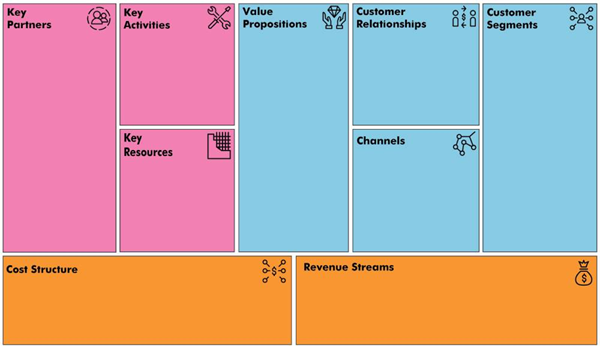
The Business Model Canvas also called the Pignut and Osterwalder business model consists of nine essential parts: Customer Segments, Value Proposition, Revenue Streams, Channels, Customer Relationships, Key Activities, Key Resources, Key Partners, and Cost Structure. The Business Model Canvas is a strategic management template that helps businesses to describe, design and analyse their business models. Alex Osterwalder modelled this strategic toll who is a Swiss business management theorist and entrepreneur. He designed this model as a part of his PhD research. In Osterwalder’s model his PhD supervisor Yves Pigneur has co-authored the model. This model was published in a book called Business Model Generation.
During the model development of Osterwalder and Pigneur by an amazing crowd of 470 practitioners from 45 countries contributed their thoughts and experiences. That is an inspiring collaboration. The model is in the form of a visual chart with various elements that describe the value proposition of an organisation, its infrastructure, market and finances. The objective of the model is to assist firms to align their activities through the illustration of potential trade-offs.
This article explains the basics of the Business Model Canvas. The model comprises nine building blocks. They are explained as follows:
Value proposition of the business: Apple’s value proposition lies deeply in design, branding, and innovation. Banking on creativity, the brand sets its products and services apart using aesthetics, advanced technology, and user experience. Value proposition refers to the product or service the firm intends to offer to its customers to satisfy their needs. It is unique to an organisation as it helps to differentiate the product apart from its competitors. The description may be qualitative, outlining the intended outcome and customer experience, or quantitative, describing the efficiency and price. Nike bases its value proposition on the practice of sport as a generator of confidence and success, will and effort, going against what is established, and bringing inspiration and innovation to every athlete in the world.
The business proposition (value proposition) is at the centre of the Business Model Canvas because it is the core offering that answers why customers would choose one company over another, thus serving as the heart of the business model that the other components revolve around. It directly connects the value created to the specific problems or needs of the customer segment, making it the fundamental reason for the business’s existence and the driver for all other strategic decisions.
Infrastructure: Number ofIndian organizations stand out for their strong infrastructure in word. Larsen & Toubro (L&T) is a major player known for its diverse portfolio and engineering expertise. Hindustan Construction Company (HCC) is recognized for its experience in large-scale civil engineering projects. Additionally, GMR Infrastructure and Reliance Infrastructure are also prominent in the infrastructure and real estate sectors. It’s shown on the left of the canvas.
In a value chain model, infrastructure refers to the all-encompassing systems, processes, and resources that support the entire organization and its operations, rather than specific activities like production or marketing. It includes elements like strategic management, finance, accounting, legal, and quality management, which are crucial for the overall functioning and success of the business. Value chain consists of all processes of the business adding value to the final product/service.
The organisation’s infrastructure comprises the key activities that generate the value proposition, the key resources it used to create value for its customers, its alliances or key partner networks and the things that motivate them to be part of the business model. These describe how the company delivers the value proposition.
Channels
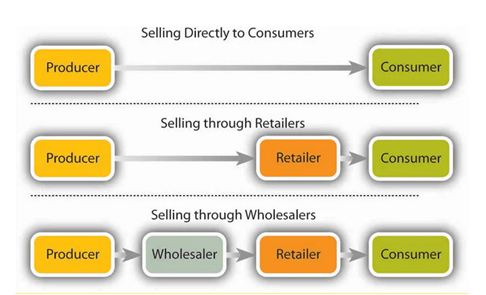
In a business context, channels are the ways a company communicates with, delivers value to, and interacts with its customers to fulfil its business proposition. They are the pathways through which a business reaches its target audience, provides its products or services, and builds relationships. Channels outline the ways a business communicates with and reaches its customers to deliver its value proposition. Hindustan Unilever (HUL) employs a multi-channel approach to reach consumers, including traditional retail, modern trade, e-commerce, and specialized channels like health and wellness stores. They also utilize direct selling and direct-to-consumer strategies, particularly in rural areas through initiatives like Project Shakti. HUL leverages a vast network of distributors and stockists to ensure product availability across various locations.
Customers
On the right side of the canvas, the model analyses three aspects of the customers of the business. They include customer segments break the total market down to help identify and describe its target customers more specifically, channels of delivery connect a customer segment to the value proposition and the type of relationship between the business and its customers. For example, transactional, long-term, self-service, co-creation, etc. Considered together, these describe how the customer expects to access the value proposition. Airbnb has two main customer segments – travellers seeking accommodation and property owners renting out their spaces. Uber connects drivers and riders. Spotify targets music lovers, artists, and advertisers.
Revenue streams
It describes how the company makes money from its target market. For example, businesses can generate revenue through the sale of a physical product, selling a continuous service in the form of subscriptions, renting, or leasing an asset such as a car, licensing or charging fees to advertise products. For example, Tata Motors generates revenue from multiple streams including commercial vehicles, passenger vehicles, electric vehicles, and the Jaguar Land Rover (JLR) segment. They also have revenue from vehicle financing and related services. Tata Motors sells a wide range of vehicles, including passenger cars, trucks, buses, and defence vehicles. These vehicles are sold in over 170 countries worldwide, making Tata Motors one of the most globally diversified automotive companies.
Key Activities
Key activities are the essential things a business needs to do to bring its customers value. Key activities are arrived at more through acumen and enumerating the steps needed to deliver value, than by doing business research. There are 3 categories of key activities; production: designing, manufacturing and delivering a product in significant quantities and/ or of superior quality. Problem-solving: finding new solutions to individual problems faced by customers. Platform/ network: Creating and maintaining platforms. ITC’s key activities span across diverse business segments including cigarettes, FMCG, hotels, paperboards, packaging, and agribusiness. Within these, they focus on strategic analysis, supply chain management, and input tax credit management. Furthermore, ITC actively engages in social responsibility initiatives, such as watershed development, afforestation, and sustainable agriculture.
Key Resources
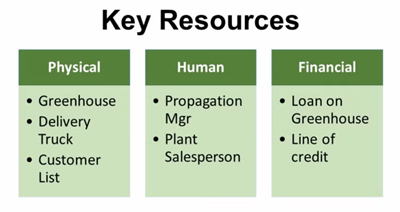
Identifies the most important assets required to make a business model work. These resources enable a company to create and offer value, reach customers, maintain relationships, and generate revenue. Key resources can be physical, financial, intellectual, or human. In Philips India’s Business Model Canvas, key resources can be broadly categorized into physical, intellectual, human, and financial resources. These resources are essential for the company’s operations and achieving its goals in the healthcare and home care sectors. The physical resources of Philips India’ include manufacturing facilities, production equipment, distribution networks, and any physical infrastructure necessary for delivering products and services. The intellectual resources include Philips’ patents, trademarks, and proprietary technologies, including AI algorithms used in diagnostic imaging and digital health solutions. Philips India relies on its skilled workforce, including engineers, researchers, and healthcare professionals, who possess the expertise to design, develop, and deliver innovative solutions.
Key Partners
They represent the external entities with whom a business collaborates to create and deliver value. These partnerships can include suppliers, strategic alliances, joint ventures, or buyer-supplier relationships. For example, P&G’s global reach is heavily reliant on strategic partnerships. A key example is their collaboration with Walmart, focused on optimizing supply chain efficiencies through data analytics and shared information systems. This partnership has led to reduced inventory levels and improved product availability for both companies. P&G partners with EY to enhance manufacturing performance and supply chain operations. This includes leveraging EY’s global experience and P&G’s certified consultants, along with tools like Supply Network Operations (SNO) and the Run-to-Target (RTT) Transformation Accelerator. The company collaborates with GLAAD to promote LGBTQ+ inclusivity in advertising and marketing, ensuring authentic and accurate representation. This partnership involves evaluating and improving representation from pre-production to post-production and beyond. It has a long-standing partnership with WWF, focusing on environmental conservation and sustainability initiatives.
Cost Structure
The Cost Structure block on the Business Model Canvas outlines all the costs associated with operating a business. It details the most significant expenses incurred in creating and delivering value, maintaining customer relationships, and generating revenue. Understanding the cost structure is crucial for optimizing operations, reducing inefficiencies, and ensuring profitability. Bata, as a large retailer, would also have significant costs associated with its supply chain, including sourcing, logistics, and distribution. Manufacturing cost includes the cost of raw materials, labor for production, factory overhead (rent, utilities), and machinery maintenance. Since Bata has its own manufacturing facilities, these costs are crucial. Retail operation cost covers the costs of running physical stores, including rent, utilities, store staff salaries, visual merchandising, and point-of-sale systems. Bata spends significantly on marketing to promote its brand and products. This includes advertising campaigns, promotional events, and digital marketing efforts. Bata is synonymous with the school going children for the leather and canvas shoes in India. Bata is known for school shoes around the world. For generations, Bata has been part of their childhood memories, helping millions of students step confidently into their future. With a portfolio of over 20 brands.
Conclusion
The Business Model Canvas is used by both startups and existing businesses, including large corporations. With a little adaptation of the ideas, non-profits and social enterprises can also use the canvas. The canvas is easy to draw on a whiteboard or a big piece of paper and you can use sticky notes to add ideas or details to each block. Whether someone is launching a startup or reinventing an existing business, this model provides a clear framework for mapping out who their customers are, what they value, and how their organization can deliver that value while generating sustainable revenue. By breaking down the complex world of business strategy into nine essential building blocks, the authors offer a practical toolkit that has revolutionized how companies think about their fundamental operations.
References
- https://scholar.google.co.in/citations?view_op=view_citation&hl=en&user=4GAKY4sAAAAJ&citation_for_view=4GAKY4sAAAAJ:vV6vV6tmYwMC
- https://www.strategyzer.com/library/the-business-model-canvas
- https://hbr.org/2013/05/a-better-way-to-think-about-yo
- https://www.itcstrategies.com/
- https://www.intracen.org/our-work/topics/business-environment/trade-development-strategies
- https://www.business-standard.com/companies/news/hul-kirana-distribution-samadhan-strategy-124123100260_1.html
- https://vace.uky.edu/sites/vace/files/downloads/9_business_model_generation.pdf
- https://www.philips.com/a-w/about/our-strategy.htm
- https://iide.co/case-studies/the-business-model-of-philips/
- https://supplychaindigital.com/digital-supply-chain/hindustan-unilever-wins-digital-supply-chain-at-p-sc-awards

