
































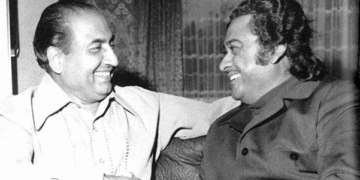







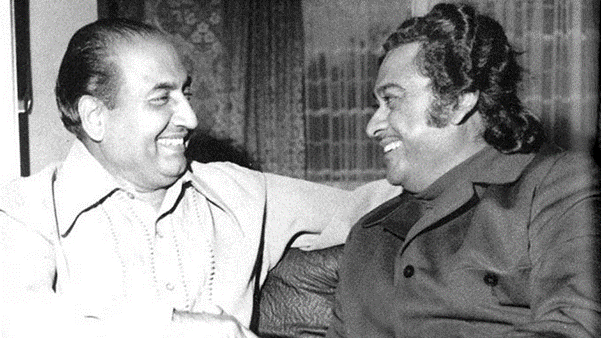
The “camaraderie” or companionship shared between Mohammed Rafi and Kishore Kumar was a respectful and supportive friendship between two legends of Indian playback singing, characterized by their professional collaboration, mutual admiration, and the creation of timeless songs despite the fan-driven comparisons between their unique styles.
Kishore Kumar could sing songs of a wide range of emotions. His voice was known for its ability to convey a broad spectrum of emotions, from the tender romanticism of love songs to the infectious energy of party anthems. He could effortlessly shift between different moods, from joyous to tragic, and between various genres, including ballads and energetic tracks. Kishore connected with actors by becoming their voice on screen. A key aspect of his versatility was his remarkable ability to adapt his voice to match the specific persona and mood for different actors, from Dev Anand, Amitabh Bachchan to Rajesh Khanna, creating a unique connection with each.
Mohammed Rafi’s voice was unique due to his extraordinary versatility, incredible vocal range, and exceptional ability to convey emotion and adapt to various actors’ personalities and song moods. His voice had a distinctive texture that was simultaneously smooth, pure, forceful, and capable of soaring to high notes or plunging to deep, solemn tones. This blend of natural talent and technical skill made him a “Voice of God” and the definitive “Emperor of Melody” Both Rafi and Kishore share a good comradery .
During their individual musical journeys Kishore Kumar refused to sing songs because he felt were better suited for Mohammed Rafi’s voice, often due to the song’s genre or mood, which included qawwalis, classical-based songs, or other styles he wasn’t comfortable with. He prioritized artistic integrity and believed Rafi was the better choice for these specific songs, which were then sung by Rafi. Examples include “Nafrat Ki Duniya” from Haathi Mere Saathi and “Wada tera wada” from film Dushman.
Kishore Kumar, despite his immense talent, was not as comfortable singing certain musical forms like pure qawwalis or classical-based songs. He recognized when a particular style or mood was better suited to Mohammed Rafi’s vocal prowess.
In some cases, Kishore Kumar’s refusal stemmed from a deep respect for Rafi, acknowledging that Rafi’s voice was the superior choice for the composition. Kishore Kumar did indeed suggest Mohammed Rafi’s name for the song “Chal Kahin Door Nikal Jayen” from the film ‘Doosara Aadmi’, which also featured Rafi in other films by the same composer. The song is a classic and was released in 1977. In the song Rafi has a brief part to sing. But Rafi has made it so lively and energetic which is picturised on Shahshi Kapoor. Watch the video below:
In another incident, Kishore refused to sing a song from film Abhimaan. The movie was inspired by Kishore Kumar and his first wife Ruma Guha Thakur. Both married in 1951 Ruma was a successful singer and actress of Bengali cinema. Then, Kishore Kumar was the struggling actor and singer during that period. Kishore wanted that Ruma should stay home and take care of his family. But Ruma wanted to continue her career. Due to this conflict, they had problems in their married life. At last, they got separated in 1958. When Kishore refused to sing this song “Teri Bindiya Re” music director S.D.Burman chose Mohammed Rafi to sing the song “Teri Bindiya Re.” Versatile Rafi sahab modulated his voice according Amitabh Bachchan’s voice and sang it very beautifully. This song became the biggest hit of the year 1973.
One more such song from movie Thokar 1974 which was produced on a tight-string budget with new actors had two very beautiful songs one sung by Mukesh and the other by Rafi. The song “Aapani Aankhon me basakar” was initially offered to Kishore. The song illustrates the truth that love has only one constraint- it should be between two devoted souls. Kishore suggested the composer that the song should be sung by only Mohd. Rafi. If there is a devoted soul to understand the feel of love, you need not have the eyes to see the beauty of it, nor do you need the words to express the feelings of your heart. Kishore refused to sing this song because it required a yearning in voice, it was a serious song. He strongly felt only Mohd. Rafi would do justice to this song. Sajan Dehelvi lyricist, Shyamji Ghanshyamji the composer and legendary Mohd Rafi immortalized this song picturised on an unknown actor Baldev Khosa.

