











































The supply chain is as important as a backbone of businesses and the global economy, connecting raw material sources to the end consumer by managing the flow of goods and information, ensuring efficiency, quality, and timely delivery. This intricate system is crucial for providing products, boosting economic activity, modifying risks like disasters and geopolitical events, fostering innovation, and creating a competitive advantage for businesses.
Supply chain risks can cause big problems for firms. These risks come in many forms. Natural disasters, cyber-attacks, and supplier issues can all disrupt the flow of goods. The COVID-19 pandemic showed how fragile supply chains can be. Many companies struggled to get parts and materials. This led to empty shelves and angry customers. To cope, firms need to build supply chain resilience. This means having backup plans and suppliers. It also means using tech to spot problems early. Smart firms keep extra stock of key items too.
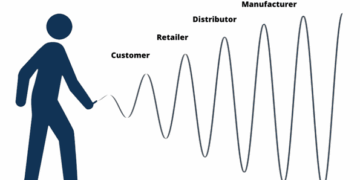
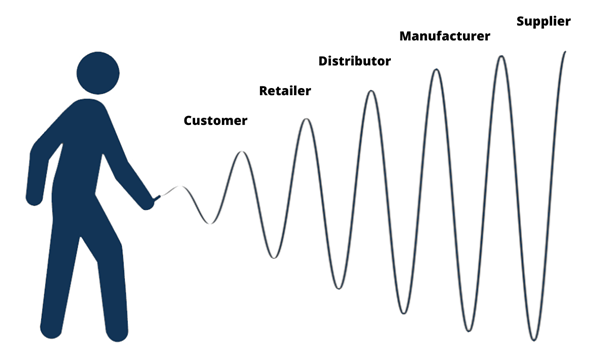
The bullwhip effect is a phenomenon in supply chain management where small changes in consumer demand create increasingly enlarged and distorted order quantities as they move up the supply chain from retailers to wholesalers to manufacturers. This exaggeration of demand leads to excess or insufficient inventory, higher costs, and reduced efficiency. It occurs because each stage in the supply chain lacks perfect information about actual consumer demand and tends to overreact to perceived changes, creating a ripple effect like a whip’s increasing motion.
The term “Bullwhip Effect” was first coined by Procter & Gamble researchers in the early 1990s. It described the phenomenon they observed in the supply chain for their Pampers brand diapers. They noticed that small changes amplified consumer demand as they moved up the supply chain, leading to significant inefficiencies and increased costs.
The bullwhip effect in a supply chain is when small changes in final consumer demand are magnified into increasingly larger fluctuations in orders as they move upstream to distributors, wholesalers, and manufacturers. This distortion causes parties to overcompensate for perceived changes in demand, leading to inefficient overproduction, excess inventory, stockouts, increased costs, and supply chain disruptions.
P&G experienced though the demand for their best-selling Pampers diapers was stable, the orders placed by retailers, distributors, and their own suppliers showed progressively larger fluctuations, leading to inefficiencies like excess inventory and increased costs. P&G coined the term to highlight this phenomenon, which they and other companies recognized as a major cause of inefficiencies in their supply chains.
Common supply chain problems include material and labor shortages, logistics challenges like port congestion and rising transport costs, demand and supply imbalances, lack of visibility, geopolitical instability, and cybersecurity threats. These issues can lead to increased costs, operational disruptions, delays in delivery, and negative impacts on customer satisfaction. Some common problems for bullwhip are as follows:
Demand Change at the Customer Level
A minor shift in consumer purchases occurs. A change in customer-level demand can disrupt a supply chain by creating sudden imbalances, leading to stockouts or excess inventory and increasing costs for businesses. This happens because the supply chain, which amplifies demand variability, struggles to react quickly enough to unexpected shifts, whether they are sudden surges or unexpected drops in demand.
Retailer Overreaction
The retailer, lacking full visibility into demand, overreacts to the perceived trend by increasing or decreasing their orders to the distributor by a larger margin. When retailers overreact to market conditions, they can cause supply chain disruptions through sudden spikes in demand (leading to shortages) or sudden drops in demand (leading to excess inventory). Overreactions, such as stockpiling or sudden order cuts, disrupt the flow of goods, causing higher costs, production halts, and potential loss of supplier and customer confidence. Effective supply chain management requires real-time visibility and intelligent demand forecasting to avoid these disruptions and ensure a smooth flow of products.
Amplified Orders Upstream
The wholesaler, receiving distorted information from multiple retailers, further inflates its own orders to the manufacturer. Where small fluctuations in customer demand become increasingly amplified as they move upstream from the retailer to the wholesaler, distributor, and manufacturer. This distortion leads to inefficiencies like excess inventory or shortages, increased costs, and operational instability, as each supply chain stage.
Magnified Demand Fluctuation
The manufacturer, with even less direct information about customer demand, drastically adjusts its production and orders from suppliers, creating the largest and most erratic swing.
Complex Supply Chain
The number of intermediaries between the manufacturer and the ultimate customer grows with a complex supply chain. Each intermediary may make assumptions about demand in a complex supply chain and place orders accordingly. Due to the sheer number of interconnected and interdependent entities, the vast amount of information and material flows involved, the global reach and multiple geographic locations of these entities, and the constant dynamic changes and disruptions that occur, making cause-and-effect relationships often unclear. These factors create a system with many moving parts that require significant coordination and can lead to cascading effects when problems arise.
Batch Orders
Batch order is a common practice in supply chain management where orders are placed in bulk at set intervals. The supplier and the retailer or distributor agree on a schedule for placing orders rather than placing orders as demand occurs. Batch ordering creates a distorted view of actual demand. This distortion of information leads to an excess inventory, which causes a stock-out or increase in holding costs. It can also lead to the bullwhip effect by creating a delay in the flow of information. This delay causes suppliers to react to changes in demand too late, leading to an oversupply or stock-out.
Consumer Pressure
Consumer pressure can cause the bullwhip effect by creating demand fluctuations that are difficult for suppliers to predict and address. It happens when consumers pressure retailers to stock a wide range of products and always have those products available. Consumer pressure leads to an overestimated demand and an increase in inventory levels. When consumers pressure retailers to stock a wide range of products, retailers place large orders to ensure they have enough supply to meet consumer demands.
Bad Communication
Distorted communication directly causes supply chain disruption by creating misaligned expectations, increasing operational costs, and leading to poor decision-making, which results in delays, shortages, and damaged relationships. This breakdown in information flow, especially in global networks, can be due to incompatible systems, data silos, security issues like cyber-attacks, or a general lack of real-time, transparent information exchange, hindering agile responses to unexpected events. It creates a lack of visibility and coordination among supply chain partners. It makes it difficult for suppliers to accurately predict demand and make informed inventory management and production levels decisions. Poor communication can lead to an overestimated demand and an increase in inventory levels, causing the bullwhip effect.
Price Volatility
Price volatility refers to the degree of price variations of a product or commodity over time. It measures how much the price of a product or commodity changes in each period. Price volatility causes the bullwhip effect by creating uncertainty and unpredictability for suppliers. The rapid fluctuation in the price of a product or commodity makes it hard for suppliers to forecast future prices. This volatility causes them to overestimate demand, leading to an increase in inventory levels and the bullwhip effect in supply.
Lead Times Issues
Lead time is the time it takes for order fulfilment, from placing an order until the goods are received. Long lead times create delays in the flow of information between supply chain partners. This delay makes it difficult for suppliers to accurately predict demand and make informed inventory and production levels decisions. For example, if a supplier has long lead times, a retailer may place large safety stock orders to ensure they have enough inventory.
Incorrect Forecasts
Suppliers, retailers, and distributors often use historical data to make future forecasts. However, when there are significant changes in demand, it may cause them to base their projections on incorrect information. This wrong projection can lead to an overestimated demand and an increase in inventory levels. Incorrect supply chain forecasts create a vicious cycle of overstocking and stockouts, leading to increased costs, reduced profitability, and damaged customer satisfaction. This inaccuracy also triggers the bullwhip effect, amplifying small errors up the supply chain into significant demand and supply imbalances.