





















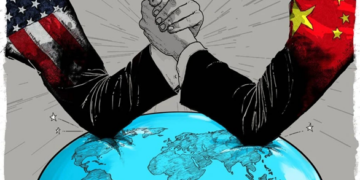

















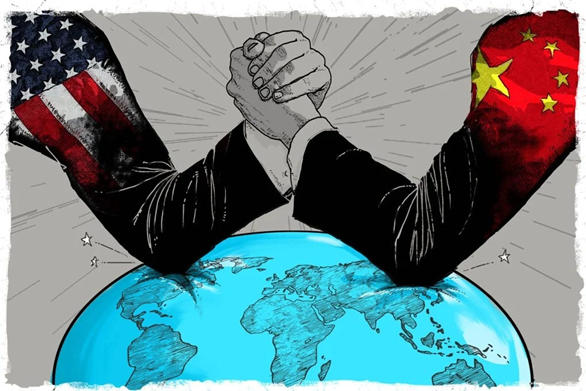
The Thucydides Trap describes the high risk of war when a rising power threatens to displace a dominant ruling power. This concept is named after the Greek historian Thucydides who noted the dynamics between Athens and Sparta leading to the Peloponnesian War.
Thucydides war was further popularized by political scientist Graham T. Allison, suggesting the fear of the rising power by the established nation, coupled with the challenger’s growing confidence, often leads to conflict, though Allison aims to help manage this dynamic (currently U.S.-China) to avoid war through understanding and diplomacy.
The origin of the Thucydides’ trap started in situation where rising power Athens challenged the status of an established, ruling power Sparta. The war was called Peloponnesian War, The Peloponnesian War was fought in the Eastern Mediterranean between the Athenian-led Delian League and the Spartan-led Peloponnesian League from 431 to 404 BC for domination over Ancient Greece. Thucydides approached ethics with scepticism, viewing morality as shaped by one’s environment rather than universal truths. Thucydides’ observations during the Peloponnesian War led him to develop political realism, the theory that political behaviour is fundamentally driven by fear of war and self-interest.
In the world wars happen due to complex, overlying reasons like disputes over resources such as land, oil, power struggles, political control, influence, and identity clashes due to religion, nationalism, ideology, often fuelled by economic inequality, historical grievances, resource scarcity exacerbated by climate change, or a breakdown in diplomacy, leading groups to use organized violence when peaceful resolution fails. For example, Pakistan’s frequent conflicts with India stem mainly from the unresolved Kashmir dispute since 1947, leading to wars and ongoing border clashes, fuelled by religious/communal tensions and strategic interests, alongside internal instability and support for militant groups impacting regional security, especially with neighbours like Afghanistan, creating a cycle of conflict. The violent 1947 split by British created a deep-seated hostility between India and Pakistan leading to religious divide between Hindu-Muslim, and a legacy of distrust.
Wars, often arising from economic, territorial, religious, or political reasons, can leave countries war-torn, requiring decades for rebuilding infrastructure and economic reconstruction. Rebuilding nations after war is indeed a daunting task, involving immense challenges across social, economic, political, and infrastructural domains. It requires comprehensive, long-term strategies and often international cooperation to establish lasting peace and stability.
The Russia-Ukraine conflict, beginning in 2022, it exemplifies the complexities of modern warfare, including unexpected resistance, strategic and logistic challenges, and significant civilian impact. On February 24, 2022, the Russian Federation began a military invasion of Ukraine, escalating a conflict that had been simmering since Russia’s 2014 annexation of Ukraine’s Crimean Peninsula.
Global war statistics reveal a diversity of conflicts, from Myanmar’s long-standing civil war to the ongoing drug war in Mexico, each with unique causes and consequences.
Myanmar’s civil war stems from the military’s 2021 coup, overthrowing a democratically elected government and triggering widespread armed resistance by pro-democracy forces and ethnic groups against the ruling junta, building on decades of ethnic conflict and military dominance over civilian rule. The core reasons are the military’s desire to retain power, suppression of democratic movements, and long-standing ethnic grievances, all exacerbated by the military’s violent crackdown on peaceful protests after the coup.
The Mexican drug war is an ongoing lopsided armed conflict between the Mexican government and various drug trafficking syndicates. When the Mexican military intervened in 2006, the government’s main objective was to reduce drug-related violence. This conflict has resulted in widespread violence, including mass killings and brutal tactics employed by the cartels, such as execution-style murders and the use of mass graves. The conflict known as the Mexican Drug War is still very much ongoing as an intense armed struggle between the Mexican government and powerful drug cartels, despite various government initiatives and claims of ending the “war,” with cartels like the Sinaloa Cartel remaining dominant players in the multi-billion-dollar drug trade, driving violence and instability.
The conflict between Israel and Palestine is a long-running, complex dispute over land and self-determination with historical roots stretching back over a century. It encompasses a series of wars, numerous military operations, and ongoing political conflict, most notably the current Israel-Hamas war in Gaza. The Palestinians seek to establish their own independent state in at least one part of historic Palestine. Israeli defence of its own borders, control over the West Bank, the Egyptian-Israeli blockade of the Gaza Strip, and Palestinian internal politics currently make the Palestinians’ goal out of reach. The Israeli–Palestinian conflict is an ongoing military and political conflict about land and self-determination within the territory of the former Mandatory Palestine.
Civilization Identity will be increasingly important in the future, and the world will be shaped in large measure by the interactions among seven or eight major civilizations. These include Western, Confucian, Japanese, Islamic, Hindu, Slavic-Orthodox, Latin American and possibly African civilization.
The Soviet-Afghan war and the First Gulf War as the emergence of civilization wars. Huntington interprets the Afghan War as a civilization war because it was the first successful resistance to a foreign power, which boosted the self-confidence, and power of many fighters in the Islamic world says American political scientist Samuel Huntington.
Cold Wars are increasingly appearing at these civilizational divisions. Wars such as those following the breakup of Yugoslavia, in Chechnya, and between India and Pakistan were cited as evidence of inter-civilizational conflict.
Impact of clash of civilization on business
According to a study by the Harvard Business Review, a staggering 70% of international ventures fail due to cultural differences. This alarming statistic underscores the critical need for mastering cross-cultural communication. Because human societies are complex systems, some common factors that may contribute to their decline are economic, environmental, demographic, social and cultural. These factors may cascade into another and build up to the point that could overwhelm any mechanisms that would otherwise maintain stability.
Culture clash in the workplace refers to the conflict that arises when different employee backgrounds, beliefs, and behaviours collide. This can manifest in various ways, including: miscommunication, diverse communication styles can lead to misunderstandings and frustration. Also, cultural clashes disrupt businesses.
Increased Trade Costs and Reduced Flows
Cultural differences act as a significant, and in the post-Cold War era, potentially increasing barrier to international trade. Countries belonging to different civilizations tend to trade less with each other. This is due to higher transaction costs, a lack of trust, and differing business norms which complicate negotiations and collaboration.
Foreign Direct Investment (FDI) Risks
Businesses investing overseas face “cultural risks” in regions with vastly different languages, religious beliefs, legal origins, and values. These risks can lead to potential operational challenges, social tensions, and the need for significant adaptation to local cultural norms, which can be costly and difficult to manage.
Geopolitical Conflict and Instability
The theory posits that conflicts will primarily occur along “fault lines” between civilizations. This increases the risk of regional instability, proxy conflicts, and “tit-for-tat” sanctions (e.g., in trade and finance) which can disrupt global supply chains, catch businesses in the middle of political disputes, and increase compliance costs.
Challenges in Mergers and International Operations
Within organizations, a clash of corporate cultures, often exacerbated by different national or regional operating styles, can lead to communication breakdowns, demotivation, resistance to change, and a lack of cohesion in teams. This makes successfully integrating acquired companies or managing diverse global operations a major challenge.
Reinforced Economic Regionalism
The theory suggests that successful economic regionalism often succeeds only when it is rooted in a common civilization. This trend toward stronger intra-regional trade blocs (e.g., in Europe, East Asia, North America) could lead to the marginalization of businesses from outside those blocs, making cross-regional expansion more difficult.
Weaponization of Trade and Finance
The intensification of civilizational competition can lead to the “weaponization” of economic tools, such as trade tariffs, sanctions, and restrictions on technology transfers, in “nationally sensitive” domains for example, semiconductors, clean energy. This environment of economic warfare forces businesses to navigate a complex, fragmented international system.

