






































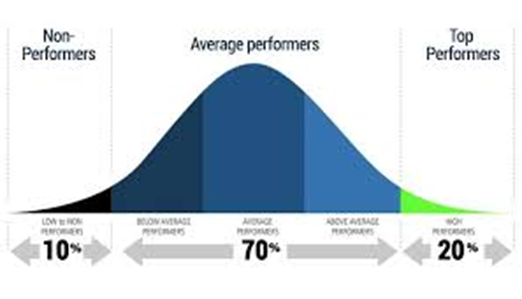
Bell curve performance appraisal is a method used in Human Resources to evaluate employee performance. This system groups employees into different performance levels based on a distribution that resembles a bell-shaped curve. The bell curve performance appraisal method was made famous and widely adopted by Jack Welch, the former CEO of General Electric (GE), in the 1980s. Although the concept of the bell curve as a statistical distribution predates Welch’s use of it, his implementation at GE popularized its application in performance management.
Many large organizations, particularly in the IT and banking sectors, have conventionally used bell curve-based performance appraisal systems. Examples include Infosys, Wipro, and ICICI Bank. Some public sector undertakings in India such as ONGC and SAIL, also use this method. In the Bell Curve system, a small percentage of employees are classified as top performers, the majority fall into the average category, and a small percentage are identified as nonachievers. The bell curve appraisal in HR helps organizations to systematically assess and rank their employees, ensuring that the distribution of performance ratings aligns with the expected parameters of mission and vision of the organization.
The bell curve is used to categorize employee performance and differentiate between top, average, and underperforming individuals. This system aims to ensure that a certain percentage of employees are in each category, which helps with reward systems, and performance improvement. HR departments use the bell curve performance appraisal to identify and compensate top performers, provide additional training and development for average performers, address ssues with underperformers through feedback and improvement plans. Therefore, this method is preferred by HR departments, promoting a culture of high performance and continuous improvement within the organization.
The bell curve was widely adopted, but now a days, several companies have moved away from it, including Google, Microsoft, and Adobe. These organizations have adopted more flexible performance management systems, focusing on individual strengths and development rather than strict groupings. The bell curve adapts to strict parameters by maintaining a consistent shape and statistical properties when applied to various data sets. This means that regardless of the specific data being analysed, the bell curve will always be centred around the statistical mean, with most data points bundled around the central value and fewer points at the extremes.
Employee performance distributions often resemble a bell-shaped curve due to several factors, including the inherent nature of human capabilities and the way performance is assessed. The bell curve, also known as a normal distribution, suggests that most individuals will fall within a certain range of performance, with fewer people at the extreme ends
Why does the Bell Curve Work in Performance Management?
Bell curve performance appraisal is a structured method used in performance management to categorize employees based on their performance. Managers assess the performance of their team members over a specific period. This evaluation is based on predefined criteria, such as meeting targets, demonstrating key competencies, and contributing to team objectives. Employees are then ranked from highest to lowest performance. This ranking is typically done by comparing individual performances relative to each other rather than against an absolute standard.
Distribution
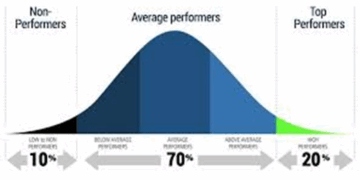
The ranked employees are divided into different performance categories following the bell curve distribution: Top Performers (Top 10-20%): These employees exceed expectations and deliver exceptional results. Average Performers (Middle 60-80%): These employees meet the expected performance standards. Low Performers (Bottom 10-20%): These employees fall below expectations and need improvement.
Feedback and Development
Based on their ranking, employees receive feedback. Top performers may receive rewards and recognition, average performers get constructive feedback to maintain their performance, and low performers are given specific training and reskilling plans as additional support.
Objective Evaluation
The bell curve provides a structured and objective approach to evaluating employee performance by categorizing employees into predefined performance levels, it reduces biases and ensures fairness in assessments. This method helps in clearly distinguishing between top performers, average performers, and low performers. This differentiation is crucial for making notified decisions about promotions, rewards, and development needs.
Motivation and Competition
By recognizing top performers, the bell curve fosters a competitive environment that motivates employees to excel. Knowing that outstanding performance will be rewarded encourages employees to strive for higher achievement.
Resource Allocation
The bell curve helps organizations allocate resources effectively. Top performers can be given challenging projects and leadership roles, while underperformers can be provided with targeted training and support to improve.
Consistency in Appraisals
Using a standardized method like the bell curve ensures consistency across departments and teams. This uniformity helps maintain a cohesive performance management in organization. For example, General Electric (GE) famously used the bell curve performance appraisal system to rank employees and drive performance improvements. By identifying the top 20% of performers, rewarding them, and addressing the bottom 10% through improvement plans or other measures, GE was able to maintain high standards of performance across the company.
GE’s growth and success are often linked to the implementation of a performance management system that utilizes the bell curve, also known as a forced ranking or vitality curve. This system was championed by former CEO Jack Welch who assumed that employee performance must follow a normal distribution. A small percentage being high performers, the majority being average, and a smaller percentage being underperformers. By identifying and often removing underperformers, GE aimed to create a more efficient and high-performing workforce. These advantages make the bell curve performance appraisal a valuable tool for organizations seeking to enhance their performance management processes, ensuring that they recognize and nurture talent effectively.