































Abstract
Every day, experts across industries are provoked with importance of artificial intelligence and its growing impact. People are concerned about their jobs and salaries about whether they will be continued in the job or not. They feel concerned that their work will be taken over or rendered archaic by the ever-growing and ever-evolving plethora of AI tools and systems. Organizations constantly require labor with a variety of skills. The demand for specific skills changes over time due to technological advancements, industry shifts, and evolving business needs. This demands a dynamic workforce capable of adapting to these changing requirements.
The proverb “adapt or perish” is a strong simile for organizational survival in a constantly changing business environment. It emphasizes the importance of adaptability and flexibility for organizations to thrive and avoid becoming obsolete. In essence, businesses must be able to adjust to new technologies, customer demands, and market trends to remain competitive.
Organizations sometimes remove employees due to a mismatch between their skillsets and the evolving needs of the business, or because of a change in company strategy or structure. This can involve layoffs, restructuring, or offering employees alternative opportunities within or outside the company. Companies like Airbnb, Amazon, Google, LinkedIn, and Meta have all announced layoffs or reductions in their HR and recruitment strategies. This indicates a shift in focus of companies prioritizing people with newer skills and cost-cutting and streamline operations during challenging economic times.
Companies like JioStar, formed through the merger of Viacom18 and Disney Star India, are laying off employees as part of a restructuring effort to eliminate overlapping roles and streamline operations.
While it’s essential for organizations and their team members to come to grips with how AI will impact them, it’s also essential to remember that there is certain invaluable abilities and traits AI can’t replicate, such as intellect, soft skills, leadership though technology is opening a host of new opportunities. Some human skills are in more demand than ever in the age of AI, as well as essential traits and expertise which are always in demand.
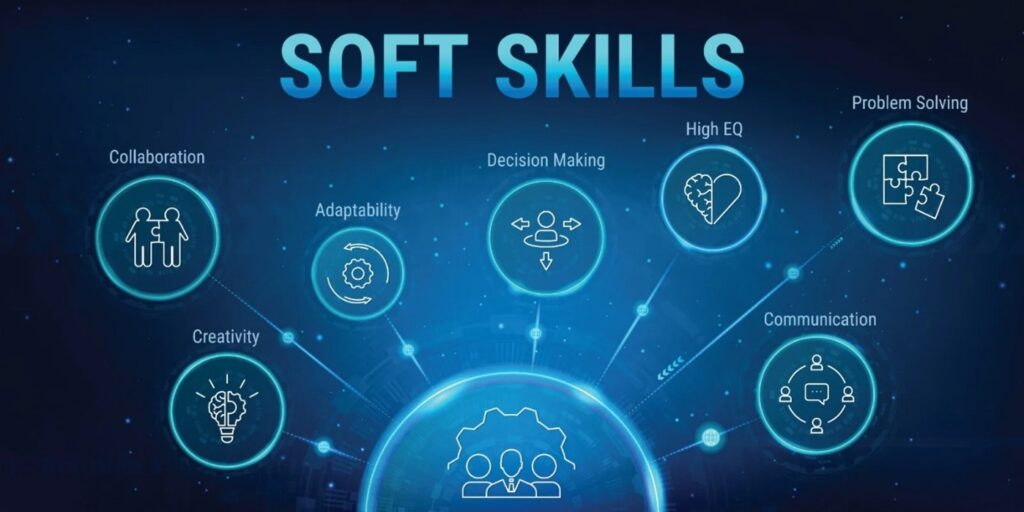
Artificial intelligence is indeed artificial. It refers to technologies and systems designed to mimic human intelligence, but these systems are not fundamentally human or natural. They are created by humans and operate based on algorithms and data, rather than natural biological processes. In a future increasingly shaped by AI and automation, human skills like communication, critical thinking, creativity, and emotional intelligence will remain highly valuable. Adaptability and leadership will also be in demand as businesses need individuals who can navigate change and guide teams.
Communication
Communication skills are crucial for success in all areas of life, enabling individuals to express themselves effectively, build relationships, and achieve goals. They are essential for understanding others, resolving conflicts, and fostering teamwork. In a professional context, strong communication skills are vital for clear information transfer, building trust, and enhancing productivity. It is vital for employees because it facilitates the sharing of vision, direction, and information, ultimately driving team consistency and success. Strong communication enables leaders to inspire, motivate, build trust, and manage conflicts effectively, creating a positive and productive work environment. Strong communication skills are essential for conveying information, collaborating with others, and building relationships, even in a world with AI. Narayana Murthy has been praised for his ability to articulate complex ideas and build a strong sense of purpose within Infosys.
Critical Thinking
The ability to analyse information, solve problems, and make informed decisions is critical in a world where algorithms and data are becoming increasingly important. Critical thinking is the ability to analyse information objectively and rationally to form judgments or make decisions. It involves questioning assumptions, recognizing biases, and considering multiple perspectives. This process is crucial for evaluating information, solving problems, and making informed decisions. The chairman of Wipro, Azim Premji, has overseen the company’s transformation from a small oil business to a global IT services provider. Azim Premji emphasizes the importance of critical thinking and continuous learning for individual and societal progress. He believes in taking initiative, developing self-awareness, and seeking feedback to foster growth. Premji’s work also highlights the crucial role of education in empowering individuals and creating a more just and equitable society. His strategic vision and ability to traverse technological advancements have been instrumental in Wipro’s success. Premji’s leadership has been marked by a commitment to innovation, quality, and global expansion.
Adaptability
It means the ability to adjust readily to different conditions or situations. It involves flexibility and a willingness to change, modify, or alter one’s approach to fit new circumstances. This is a valuable skill because it allows individuals to navigate change, thrive in uncertain environments, and effectively respond to evolving situations. It’s the ability to learn quickly, adjust to new situations, and embrace change is crucial for staying relevant in a rapidly evolving job market. Kiran Mazumdar-Shaw navigated a nascent biotech industry with Biocon, offering innovative healthcare solutions. Her ability to reel Biocon from a small, early-stage company to a global biopharmaceutical leader, demonstrating resilience and agility. Her experiences, including being denied a job due to gender bias and initially struggling to secure funding, powered her adaptability and determination. She embraced challenges, recognized opportunities, and adapted to changing market conditions, ultimately leading to Biocon’s success. Her ability to turn Biocon towards biotechnology, identify opportunities, and embrace change allowed the company to thrive in a dynamic market. This adaptability, coupled with her focus on innovation and accessible healthcare, has enabled Biocon to expand its reach and influence globally.
Leadership
Leadership skills are crucial for individual and organizational success because they enable effective communication, decision-making, and problem-solving, ultimately leading to improved team morale, innovation, and productivity. Leaders with strong leadership skills can motivate, inspire, and guide their teams, creating a positive and productive work environment. Leaders who can communicate effectively and inspire their teams can boost morale and foster a sense of belonging of their team members. They can build trust and confidence among team members, leading to increased engagement of team members. Effective communication skills are essential for leaders to convey their vision, goals, and strategies to their teams and foster better collaboration. Shiv Nader is credited with being one of the pioneers of the computing and IT industry in India – founding HCL Technologies in a garage in 1976 as a company making calculators and microprocessors. Under his guidance as chairman for more than four decades, HCL has continued to grow in the ever-changing IT landscape – transforming from its original hardware roots, manufacturing the country’s first indigenous computers, into a more comprehensive software services organisation. In fact, HCL is one of the few global IT companies founded in the 1970s that is still alive and kicking today. Nearly 50 years later, and HCL is valued at US$11.8 billion and is among India’s largest software services provider employing more than 222,000 people in 60 countries worldwide. The 79-year-old Nadar stepped down as chairman in 2020 and handed the reins to his daughter Roshi Nadar Malhotra, though he continues as chairman emeritus and strategic advisor.
Leaders will continue to be needed to guide teams, motivate individuals, and make strategic decisions in a world where automation and AI are increasingly integrated into business processes.

Creativity and Innovation
Humans will continue to be needed for their unique ability to think outside the box, generate new ideas, and find creative solutions to complex problems. From the innovative use of technology in healthcare to frugal solutions for everyday problems, Indian ingenuity has a significant global impact. For example, Arunachalam Muruganantham’s low-cost sanitary towel machine to the development of mobile banking and financial services that have reached millions. Arunachalam Muruganantham is a social entrepreneur known for inventing a low-cost sanitary pad-making machine. He is credited with making affordable sanitary pads accessible to women in rural India and creating grassroots awareness about menstrual hygiene. His invention has been praised for empowering women and promoting health and dignity. He has been instrumental in raising understanding about traditional unhygienic practices around menstruation in rural India. A movie titled ‘Pad Man’ was made about him in 2018.
Emotional Intelligence
Understanding and managing emotions, building trust, and fostering collaboration are key for navigating the social and emotional complexities of the workplace. In the fast-growing industrial world people are realising the need of emotional intelligence like never before. Emotional Intelligence (EI) is the ability to manage both your own emotions and understand the emotions of people around you. The father of EI Daniel Golman says managers with emotional intelligence (EI) achieve objectiveness through their self-awareness, which promotes productive, motivated, and equal workplaces There are five key elements to EI: self-awareness, self-regulation, motivation, empathy, and social skills. Late Ratan Tata, the former chairman of Tata Group, is a well-known example of an Indian industry leader with high emotional intelligence. His leadership is characterized by empathy and ethical and compassionate leadership. He prioritized the well-being and development of employees, creating a sense of belonging and purpose.
Technology skills
The fastest-growing skills by 2030 are.projected to be in the fields of technology, specifically AI and big data, cybersecurity, and technological literacy. Beyond these technical skills, employers are also seeking individuals with creative thinking, resilience, flexibility, and agility. Additionally, curiosity, lifelong learning, and environmental stewardship are also gaining importance.
AI and Big Data
These skills are at the forefront of technological innovation and are expected to be in high demand as companies increasingly utilize AI and data analytics for various applications. It refers to the massive volumes of data generated across various sources, often too large and complex for traditional data processing systems. This data includes structured, semi-structured, and unstructured information. AI leverages vast amounts of data to identify patterns, make predictions, and automate tasks, while big data analytics utilizes AI for more efficient and insightful data analysis. This synergy enables businesses to gain a deeper understanding of their data, make better decisions, and improve overall performance. Established in 1968, TCS is a multinational IT services and consulting giant that has firmly positioned itself in the realm of data analytics. With a comprehensive suite of solutions ranging from predictive modelling to machine learning, TCS leverages its extensive domain expertise to provide organizations with invaluable data-driven insights, facilitating informed decision-making. Today, Infosys, Accenture, Wipro, MU Sigma, Genpact are some leading Indian companies in the globe known for their core competence in AI and Big Data.
Cybersecurity
Cybersecurity in India is a growing concern due to increased digital penetration and cyberattacks, highlighting the need for robust defence measures. Key initiatives include the National Cybersecurity Strategy, the Digital Personal Data Protection Act, and the Indian Cyber Security Coordination Centre (I4C) The National Cyber Security Policy 2013 also aims to enhance resilience against cyber threats. With the increasing reliance on digital technologies, cybersecurity professionals will be essential for protecting data and systems from threats. During rising tensions between India and Pakistan, there is a broader pattern emerging about a cyberattack on Republic channel by Pakistan, as its official social media handles are being targeted and hacked. Several official Pakistani government handles on X (formerly Twitter) are posting news about escalating conflict, as well as military impact, only to delete the original posts and stating that their accounts have been hacked. On May 7th 2025.
Technological Literacy
The ability to understand and apply technology in various aspects of work will become increasingly important as automation and digital transformation continue to reshape industries. Being tech-literate allows individuals to utilize technology to improve their efficiency, communicate effectively, and collaborate more seamlessly, both in their personal and professional lives. Frequent mobile updates require a level of tech-savviness to understand and implement them effectively. This includes understanding the purpose of updates, how to install them, and potentially troubleshooting any issues that may arise. According to the CEO of Meta, mobile phones, as we know them, would be living their last years. By 2030, they would be replaced by a more cautious and advanced technology called smart glasses. Being tech-savvy is incredibly important today. It’s no longer just about having a general understanding of technology; it’s about possessing the skills and knowledge to effectively use and adapt to the ever-evolving digital landscape, which is essential for personal, professional, and educational success.

