


































Managing interdependencies among strategic business units (SBUs) is vital for a large organization to leverage synergies and maintain competitive advantage. While SBUs are semi-independent units, their success often relies on cooperation and alignment with other units and the corporate strategy.
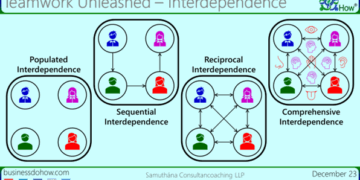
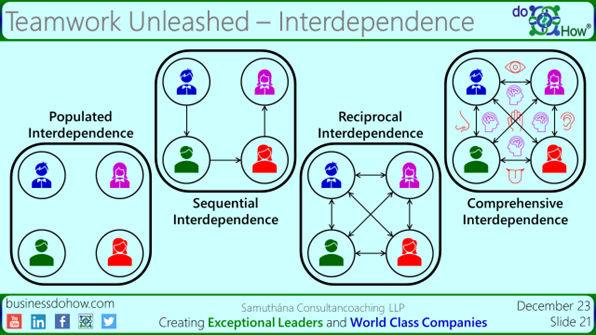
Interdependencies can range from simple, linear relationships to complex, cyclical ones and generally fall into one of three categories:
Pooled interdependence
This occurs when two or more SBUs operate independently but draw from shared resources, such as a corporate cash reserve, technology platform, or brand reputation. Their success contributes to the overall corporate performance, but they do not directly interact with each other for day-to-day tasks.
Sequential interdependence
In this lined relationship, the output of one SBU becomes the input for another SBU. For example, a manufacturing SBU might produce components that a retail SBU then sells.
Reciprocal interdependence
This is the most complex form, involving a cyclical and mutual exchange of inputs and outputs between SBUs. For instance, a marketing SBU’s research could guide a product development SBU, whose new product is then sold by the marketing SBU in a continuous loop. This example is more than just a simple sequence of events. The interdependencies are high-intensity and cyclical, with continuous information sharing and mutual adjustments required to reach a complex, high-quality final product. A failure in one area, such as a software bug in the Operating System, will continue through the impact of the hardware, applications, and cloud services, forcing all SBUs to coordinate and adjust.
I am giving here below one the best examples of interdependence amongst the SBUs of Tata Group of Companies.
The Tata Group’s “One Tata” strategy emphasizes the interdependency of its Strategic Business Units (SBUs) to create comprehensive, group-level ecosystems. By leveraging the specialized capabilities of various companies, the group can develop holistic solutions for major initiatives, such as electric vehicles (EVs) and smart cities.
To create a complete EV ecosystem, multiple Tata companies collaborate to cover every aspect of the value chain. It’s a wonderful ecosystem created by Tatas.
Tata Motors designs, manufactures, and sells the actual electric passenger cars (like the Nexon EV) and commercial vehicles.
Tata Power establishes the charging infrastructure by setting up charging stations in public, semi-public, and residential areas.
Tata Chemicals manufactures lithium-ion battery cells for the EVs. It is building a dedicated plant for this purpose in Gujarat.
Tata AutoComp Systems: assembles the battery packs and other components for the EVs, localizing the supply chain.
Tata Technologies provides engineering and design expertise for the development of EV platforms.
Tata Consultancy Services (TCS) develops the payments and technology platforms, such as the mobile app for customers to find charging stations.
Tata Motors Finance: offers affordable financing solutions to make EVs more accessible to consumers.
Croma (Infiniti Retail) showcases the vehicles in its retail stores to provide a unique customer experience.
This fantastic interdependency of Tata Group of Companies is an excellent example of Pooled Interdependence, Sequential Interdependence and Reciprocal Interdependence. In a pooled interdependence model, SBUs operate with relative independence but contribute to the overall success and reputation of the larger organization. This is the most common form of interdependence in a conglomerate like Tata. Tata has a brand reputation. A strong performance by any Tata company, such as Tata Consultancy Services (TCS), reinforces the “Tata” brand, which benefits all other businesses, including Tata Motors and Titan. Tata Sons and other group entities provide centralized, shared resources that individual companies can access, such as talent management platforms, sourcing services, and financial controls. This is example of Pooled Interdependencies.
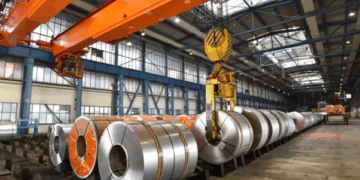
Sequential interdependence occurs when the output of one SBU becomes the input for another in a linear process. Within the Tata ecosystem, this often happens within business verticals. The manufacturing process for Tata Motors’ vehicles is an example of sequential interdependence. The assembly line requires components from a series of suppliers, including the group’s own automotive parts SBU, Tata AutoComp Systems. Tata Steel, one of the world’s largest steelmakers, supplies its products to other Tata companies, which then use the steel as a raw material for their own manufacturing processes.
Under Reciprocal interdependencies SBUs are mutually dependent and work in a back-and-forth manner to achieve a goal. This requires a high degree of coordination. The development of Tata’s EV ecosystem is a prime example of reciprocal interdependence. Tata Motors relies on Tata Power for the charging infrastructure network. Tata Power must coordinate with Tata Motors to ensure its charging solutions meet the needs of their electric vehicles. Tata Capital provides financing solutions for consumers purchasing Tata EVs, creating a feedback loop between sales, charging, and financing.

