







































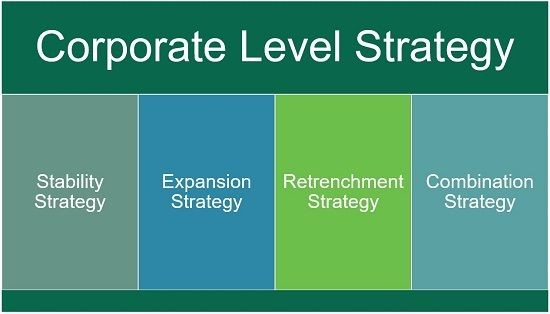
Corporate strategy is a comprehensive plan developed by top management to determine how a corporation competes and thrives within its industry. It addresses significant questions such as which businesses to engage in and how to manage various business plans. Corporate strategy can help in organisational rearrangement, problem identification, preventing counterproductive measures and creating contingency plans, proving the key to a company’s future success.
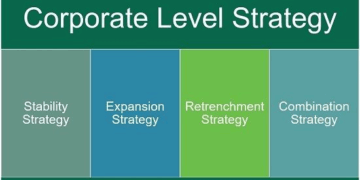
The primary aim of formulating a corporate strategy is to distribute its resources in the best way to derive maximum returns and achieve the company’s goals. There are four types of corporate strategies. We will discuss them as below.
Stability strategy
A stability strategy is often preferred by most companies the companies enjoy their market positions. They continue to explore into the same market and sell the same product but may incorporate research and development and innovation to the existing products. This type of strategy ensures a continuous flow of revenue. The company may try to engage their target market by presenting offers and trials to the customers. Coca-Cola is a classic example of stability strategy. It has maintained its strong core competence while strategically exploring market expansion opportunities. By capitalizing on its diversified brand portfolio and global reach, Coca-Cola aims for sustained growth and positive impact worldwide. The company has largely maintained its flagship product, Coca-Cola soda, over 140 years, focusing on strengthening the brand, optimizing its distribution channels, and maintaining a loyal customer base.
Expansion strategy
The expansion strategy is suitable for a firm that has already established its foothold within a certain market and aspires to grow in other markets or expand its product offerings. They may want to develop and sell new products, increase their market share or internationalise a business that has already saturated the domestic market. Expansion may involve the diversification of the business functions and thus a larger allocation of resources. This strategy results in greater returns as compared to the previous performance of the company. It can also mean more growth opportunities for the employees. Reliance Industries has showed major clean energy expansion plans at its 48th Annual General Meeting, including scaling solar module manufacturing capacity to 20 GW (Gigawatt) launching a 3 GW plant, and building a gigawatt-scale battery storage facility with an initial capacity of 40 GWh per year.
Retrenchment strategy
Sometimes, an organisation withdraws from its current position or performance to prevent itself from becoming insolvent. This may occur during an economic recession or crisis such as Covid, or if the initial business plan failed to produce the desired results. A company may implement a retrenchment (cost cutting) strategy at various levels and in different areas of the business. For example, a company may decide to completely stop the production of a particular product and thus eliminate all costs associated with it. This can reduce the number of employed staff or its fixed assets and variable costs. Retrenchment as a corporate-level strategy helps improve companies’ financial stability by reducing them in size or making their products and services less diverse. Tata Communications has been shifting away from its legacy of network services business, which faces pricing and operational challenges, toward expanding digital infrastructure and services including cloud connectivity, cybersecurity, IoT (the Internet of things), and communication platforms to build new revenue streams.
Combination strategy
This type of strategy is a combination of the stability, expansion and retrenchment. A company may adopt a combination strategy after they have weighed the pros and cons of each of their products or business units. It could be stability and retrenchment, expansion and retrenchment, or expansion and stability. Combination strategies are a mixture of stability, expansion, or retrenchment strategies. They are also called mixed or hybrid strategies and may be applied in an organization either at the same time in different businesses or at different times in the same business. Thermax is a big name in industrial boilers and heaters in India, which has used multiple combination strategies to survive and grow. The company diversified into energy conservation equipment pollution control. Thermax has signed definitive agreements for acquisition to be completed in near future with buildtechproducts and will fully acquire the balance stake of the company over the next two years while it closed its China subsidiary – TZL (Thermax (Zhejiang) Cooling & Heating Engineering Co. This is a combination strategy of expansion and retrenchment.

