







































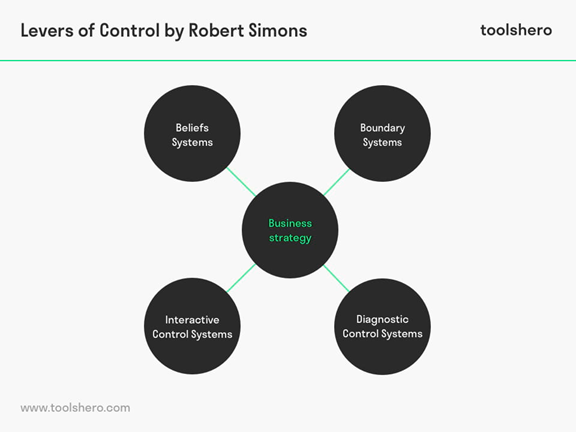
The four levers of strategy, also known as the “Levers of Control” is introduced by Harvard Business School professor Robert Simons. These are belief systems, boundary systems, diagnostic control systems, and interactive control systems. These levers are tools managers use to implement and adjust business strategies by inspiring purpose, setting limits, monitoring performance, and guiding future strategy development. These are important because they help managers balance the pressure between freedom and control, enabling them to guide their organizations toward strategic goals by ensuring commitment, defining acceptable behavior, monitoring performance, and stimulating future strategy.
Belief Systems
These are the formal and informal values, such as vision, mission, philosophies and goals. The purpose of these values and beliefs define the organization’s core purpose and inspire commitment of all stakeholders. An organization’s belief system is a set of principles, values, and assumptions that guide its employees’ thoughts, behaviours, and decisions. It provides a framework for understanding the level of competition in the industry. It helps defining purpose, and conducting business, and is often expressed through mission statements, credos, and core values. These systems influence strategic direction and shape the organization’s culture.
I am giving here example of Marico Ltd for understanding the levers of strategies. Marico’s belief system is known as “The Marico Way,” centres on innovation, inclusivity, and sustainable growth to make a positive impact on all stakeholders. This ethos is built on a set of core values and a “people-first” philosophy that treats employees as valued “members”. The Marico Way guides the company’s actions and how it behaves in everyday business. It has enabled Marico to create a unique culture. For Marico, People and Culture have always been at the core of success. Their purpose is the reason for their existence.
Marico is people-centric because it prioritizes its employees through initiatives like its “People First” ethos, focusing on a culture of trust, transparency, and empowerment, and by providing flexibility, investing in talent development, and linking employee growth to business goals through its GROW framework. The company’s strategies, such as the hybrid work model, are designed to enhance employee satisfaction, engagement, and productivity.
Boundary Systems
These systems establish the acceptable limits of freedom for employees, outlining what is not allowed to minimize risk and define the territory for experimentation and competition. A boundary system of an organization defines the limits of its operations and authority, whether they are internal or external. This can include management systems like rules and procedures to set limits on employee freedom, or specific systems that manage the interaction of the organization with its external environment, such as IT interfaces or a framework for environmental responsibility.
Marico’s “boundary system” is defined by its strong corporate governance framework, ethical code of conduct, risk management structure, and the policies and practices that promote a culture of decentralization, empowerment, and meritocracy. Instead of rigid, top-down control, the system is guided by organizational values and transparent processes that allow employees—whom the company refers to as “members” to operate with autonomy within clearly defined ethical and strategic limits.

Diagnostic Control Systems
These are traditional management control systems used to monitor, measure, and control costs, prices, and efficiency, aligning employee behavior with strategic goals. A diagnostic control system is formal system organizations used to monitor outcomes and correct deviations from performance standards. It involves tracking progress toward goals through metrics like budgets, key performance indicators (KPIs), and financial reports to ensure the business strategy is being effectively implemented. These systems are often used in a “management-by-exception” approach, where managers focus their attention on significant deviations rather than day-to-day operations.
Diagnostic control system at Marico is a traditional management control framework used to monitor and measure performance against pre-set goals and strategic plans. Drawing on Robert Simons’ “Levers of Control” framework, this system allows top management to ensure that employees are on track to achieve intended strategies without constant direct supervision. For example, quantifiable outputs are measured against a pre-determined standard. Results are compared to the standard to identify deviations. Actions are taken to correct the deviations and get the organization back on track. Marico implemented an integrated IT system, including SAP, to improve supply chain visibility and efficiency. This system provides real-time data to monitor key performance indicators (KPIs) like stock levels, order generation, and forecasting accuracy.
For its Bangladesh unit, Marico implemented diagnostics to identify and fix flaws in the sales and distribution network. This allows management to improve and align sales performance with business strategy based on specific insights.

Interactive Control Systems
These systems force managers and employees to focus on new strategic uncertainties, stimulating dialogue and learning to guide future strategy and innovation. Interactive control systems are management tools that managers use to directly and frequently engage with their subordinates on issues of strategic uncertainty. These systems are a key part of a company’s overall management control framework, focusing on tracking new ideas, triggering organizational learning, and adapting the organization’s strategy in response to changing circumstances. Examples include regular strategy meetings, innovation workshops, and cross-functional teams where managers challenge assumptions and employees are encouraged to propose new initiatives.
While a specific, public facing “Interactive Control System” at Marico is not detailed in the search results, the company’s annual reports and corporate governance documents reveal a control approach consistent with Robert Simons’ “Levers of Control” framework. In this model, an interactive control system is a formal management tool used to encourage learning and adaptation in response to strategic uncertainties.
Interactive control systems at Marico consist of digital tools and automation used across its supply chain, manufacturing, and consumer engagement, which promote dialogue and innovation rather than merely monitoring performance. These systems involve real-time data analysis and employee involvement to address “strategic uncertainties” and adapt to changing market dynamics, distinguishing them from simple diagnostic or automated systems.
