


































• Home
  • Management
    • Brand Management
    • BUSINESS ETHICS
    • Financial Management
    • General Management
    • Human Resources Management
    • Information Technology Management
    • Marketing Management
    • Operations Management
    • Real heros
    • Strategic Management
  • HIGHER EDUCATION
  • Research
  • News
    • Current Affairs
    • Political affairs
  • GENERAL
    • Food & Cooking
    • Gardening
    • Health & Wellness
    • Heritage
    • Leadership
    • Literary
    • Movies & Music
    • People and Trends
    • Plants and Greenery
    • Psychology
    • Real Heroes
    • Spirituality & Meditation
    • Travel & Tourism
Dr. Vidya Hattangadi
  • Home
  • Management
    • All
    • Brand Management
    • BUSINESS ETHICS
    • Business Management
    • Economics
    • Financial Management
    • General Management
    • Human Resources Management
    • Information Technology Management
    • Marketing Management
    • Operations Management
    • Strategic Management
    • Technology Management
    The Pigneur and Osterwalder Business Model

    The Pigneur and Osterwalder Business Model

    By 2030 in the era of AI and big data some soft skills will still be prominently required  

    By 2030 in the era of AI and big data some soft skills will still be prominently required  

    Giffen’s Goods and Giffen’s Paradox

    Giffen’s Goods and Giffen’s Paradox

    What are the Pros & Cons of remote working?

    What are the Pros & Cons of remote working?

    What are Green Bonds

    What are Green Bonds

    CAMELS Model

    CAMELS Model

    The business world needs to build collaborative culture

    The business world needs to build collaborative culture

    Why Organizations use Disruptive Market Positioning for Brand’s Success

    Why Organizations use Disruptive Market Positioning for Brand’s Success

    Comparison of SPACE Matrix with Michel Porter’s Generic Strategies   

    Comparison of SPACE Matrix with Michel Porter’s Generic Strategies   

    Trending Tags

    • Higher Education
      Experiential learning is the future

      Experiential learning is the future

      How to write an appropriate title 

      How to write an appropriate title 

      Can India regain the title of Vishwaguru?

      Can India regain the title of Vishwaguru?

      What are the problems faced in online lectures?

      What impact can Knowledge have on Society?

      A Big Salute all our teachers!!!

      What is Triple Helix Model for innovation?

      Where in the world teachers are most respected?

      What is the Triple Helix Model for Innovation

      Trending Tags

      • Research

        Importance of Citation in Research

        What is Autoethnography style of PhD

        Can scholarly articles/papers from blogs be cited in research work?

        The complete guide on how to select the right PhD topic

        All you wanted to know out how a PhD thesis is assessed?

        Mixed Method Research is Most Suitable

        What is the difference between economic bubble and economic boom?

        How to write a Research Paper?

        Case Study is one of vital type of research

        Trending Tags

        • News
          • All
          • Current Affairs
          • Political affairs
          Launch of my book  titled “International Business”

          Launch of my book titled “International Business”

          Gift City is becoming India’s Capital Gateway

          Gift City is becoming India’s Capital Gateway

          The science of Psephology

          The science of Psephology

          What is the Future of BRICS Currency?

          What is the Future of BRICS Currency?

          Ram Mandir tableau graced the 75th Republic Day of India

          Ram Mandir tableau graced the 75th Republic Day of India

          The rise of  India as a Religious Tourism Destination

          The rise of India as a Religious Tourism Destination

          Why should our history be re-written?

          Why should our history be re-written?

          Inspiring leadership of Malavika Hegde in managing crisis of Café Coffee Day CCD

          What is Protagoras Paradox?

          Trending Tags

          • General
            • All
            • Food & Cooking
            • Gardening
            • Health & Wellness
            • Heritage
            • Leadership
            • Literary
            • Movies & Music
            • People and Trends
            • Philosophy
            • Plants and Greenery
            • Psychology
            • Real Heroes
            • Spirituality & Meditation
            • Travel & Tourism
            Nine Avatars of Durga Represents Nine Stages of Woman’s Life 

            Nine Avatars of Durga Represents Nine Stages of Woman’s Life 

            Navratri – the festival of invoking Shakti

            Humans and animals love music equally  

            Humans and animals love music equally  

            Famous Educational Behaviourism Theories

            Famous Educational Behaviourism Theories

            Why Ganesha is called Ekdanta?

            Why Ganesha is called Ekdanta?

            An Architectural Marvel – Shri Vidyashankara Temple in Chikmanglur District, Karnataka

            An Architectural Marvel – Shri Vidyashankara Temple in Chikmanglur District, Karnataka

            Do intelligent people have good sense of humour?

            Do intelligent people have good sense of humour?

            What is falsetto in Music?

            What is falsetto in Music?

            I Miss My Pet – Momo  

            I Miss My Pet – Momo  

            Trending Tags

            No Result
            View All Result
            • Home
            • Management
              • All
              • Brand Management
              • BUSINESS ETHICS
              • Business Management
              • Economics
              • Financial Management
              • General Management
              • Human Resources Management
              • Information Technology Management
              • Marketing Management
              • Operations Management
              • Strategic Management
              • Technology Management
              The Pigneur and Osterwalder Business Model

              The Pigneur and Osterwalder Business Model

              By 2030 in the era of AI and big data some soft skills will still be prominently required  

              By 2030 in the era of AI and big data some soft skills will still be prominently required  

              Giffen’s Goods and Giffen’s Paradox

              Giffen’s Goods and Giffen’s Paradox

              What are the Pros & Cons of remote working?

              What are the Pros & Cons of remote working?

              What are Green Bonds

              What are Green Bonds

              CAMELS Model

              CAMELS Model

              The business world needs to build collaborative culture

              The business world needs to build collaborative culture

              Why Organizations use Disruptive Market Positioning for Brand’s Success

              Why Organizations use Disruptive Market Positioning for Brand’s Success

              Comparison of SPACE Matrix with Michel Porter’s Generic Strategies   

              Comparison of SPACE Matrix with Michel Porter’s Generic Strategies   

              Trending Tags

              • Higher Education
                Experiential learning is the future

                Experiential learning is the future

                How to write an appropriate title 

                How to write an appropriate title 

                Can India regain the title of Vishwaguru?

                Can India regain the title of Vishwaguru?

                What are the problems faced in online lectures?

                What impact can Knowledge have on Society?

                A Big Salute all our teachers!!!

                What is Triple Helix Model for innovation?

                Where in the world teachers are most respected?

                What is the Triple Helix Model for Innovation

                Trending Tags

                • Research

                  Importance of Citation in Research

                  What is Autoethnography style of PhD

                  Can scholarly articles/papers from blogs be cited in research work?

                  The complete guide on how to select the right PhD topic

                  All you wanted to know out how a PhD thesis is assessed?

                  Mixed Method Research is Most Suitable

                  What is the difference between economic bubble and economic boom?

                  How to write a Research Paper?

                  Case Study is one of vital type of research

                  Trending Tags

                  • News
                    • All
                    • Current Affairs
                    • Political affairs
                    Launch of my book  titled “International Business”

                    Launch of my book titled “International Business”

                    Gift City is becoming India’s Capital Gateway

                    Gift City is becoming India’s Capital Gateway

                    The science of Psephology

                    The science of Psephology

                    What is the Future of BRICS Currency?

                    What is the Future of BRICS Currency?

                    Ram Mandir tableau graced the 75th Republic Day of India

                    Ram Mandir tableau graced the 75th Republic Day of India

                    The rise of  India as a Religious Tourism Destination

                    The rise of India as a Religious Tourism Destination

                    Why should our history be re-written?

                    Why should our history be re-written?

                    Inspiring leadership of Malavika Hegde in managing crisis of Café Coffee Day CCD

                    What is Protagoras Paradox?

                    Trending Tags

                    • General
                      • All
                      • Food & Cooking
                      • Gardening
                      • Health & Wellness
                      • Heritage
                      • Leadership
                      • Literary
                      • Movies & Music
                      • People and Trends
                      • Philosophy
                      • Plants and Greenery
                      • Psychology
                      • Real Heroes
                      • Spirituality & Meditation
                      • Travel & Tourism
                      Nine Avatars of Durga Represents Nine Stages of Woman’s Life 

                      Nine Avatars of Durga Represents Nine Stages of Woman’s Life 

                      Navratri – the festival of invoking Shakti

                      Humans and animals love music equally  

                      Humans and animals love music equally  

                      Famous Educational Behaviourism Theories

                      Famous Educational Behaviourism Theories

                      Why Ganesha is called Ekdanta?

                      Why Ganesha is called Ekdanta?

                      An Architectural Marvel – Shri Vidyashankara Temple in Chikmanglur District, Karnataka

                      An Architectural Marvel – Shri Vidyashankara Temple in Chikmanglur District, Karnataka

                      Do intelligent people have good sense of humour?

                      Do intelligent people have good sense of humour?

                      What is falsetto in Music?

                      What is falsetto in Music?

                      I Miss My Pet – Momo  

                      I Miss My Pet – Momo  

                      Trending Tags

                      No Result
                      View All Result
                      Dr. Vidya Hattangadi
                      No Result
                      View All Result
                      Home GENERAL

                      Famous Educational Behaviourism Theories

                      Dr Vidya Hattangadi by Dr Vidya Hattangadi
                      September 1, 2025
                      in GENERAL, Psychology
                      0
                      0
                      SHARES
                      16
                      VIEWS
                      Share on FacebookShare on TwitterShare On Whatsapp

                      Understanding and influencing human behavior is crucial for a variety of reasons, people with whom we work every day, deal on regular basis, for our personal growth and strong relationships for effective teamwork and societal progress. Good behavior fosters positive environments, builds trust, and contributes to a safer and more inclusive society. It also impacts mental and emotional well-being and can influence productivity and success in various aspects of life. 

                      Personality is fixed and it’s difficult to change, so it makes sense to focus our efforts at the point where changes can be made. Since behaviour is within our condition of control, affirmative feedback on behaviour offers a positive lead for personal development, showing where and how we can adapt to meet the needs of a particular situation or job role. Counselling largely helps to change our behaviour.

                      Behaviorism is a branch of psychology which primarily studies observable actions and responses, rather than internal mental processes like thoughts or feelings. It suggests that behaviors are learned through two main types of conditioning: classical conditioning which is associating stimuli with responses and modified conditioning  which is learning through consequences of behavior. I list here below few famous theories of behaviourism.

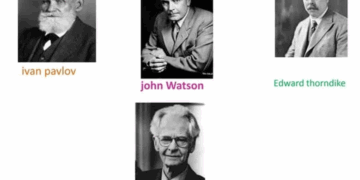
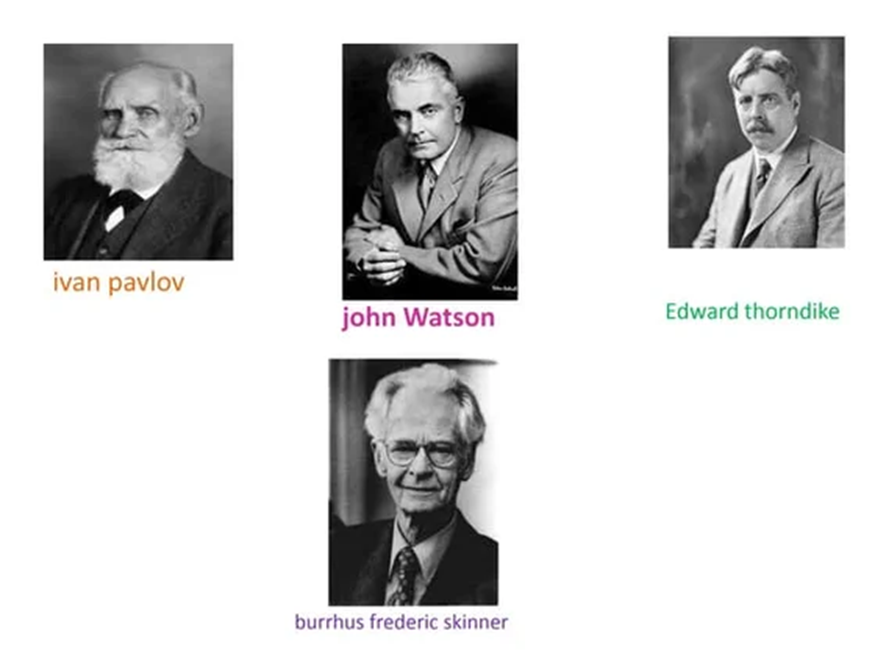
                      John B. Watson’s classical behaviourism

                      Watson’s theory focused on observable behavior as the primary subject of psychological study, rejecting introspection and mental processes. He believed that behavior is learned through conditioning and can be manipulated by environmental stimuli, emphasizing the role of external factors over internal ones. His experiment famously known as ‘the little Albert experiment’, conducted by John Watson and Rosalie Rayner in 1920, aimed to demonstrate that fear could be conditioned in humans through classical conditioning. The experiment involved a nine-month-old baby, Albert, who was initially not afraid of a white rat. Researchers repeatedly paired the rat with a loud, startling noise, causing Albert to associate the rat with the noise and eventually fear the rat itself. The white rat was initially a neutral stimulus, meaning Albert didn’t have an innate fear of it. The loud noise was the unconditioned stimulus, which naturally caused fear in a way the unconditioned response in Albert. 

                      Watson argued that only behaviors that can be observed and measured objectively are valid in scientific psychology. He believed that behaviors are learned through conditioning, where provocations in the environment are paired with responses, leading to learned associations. Watson rejected the study of thoughts, feelings, and other internal mental processes, arguing that they are not directly observable and therefore not suitable for scientific study. Watson emphasized the role of environmental factors in shaping behavior, suggesting that individuals can be trained to exhibit specific behaviors through conditioning. 
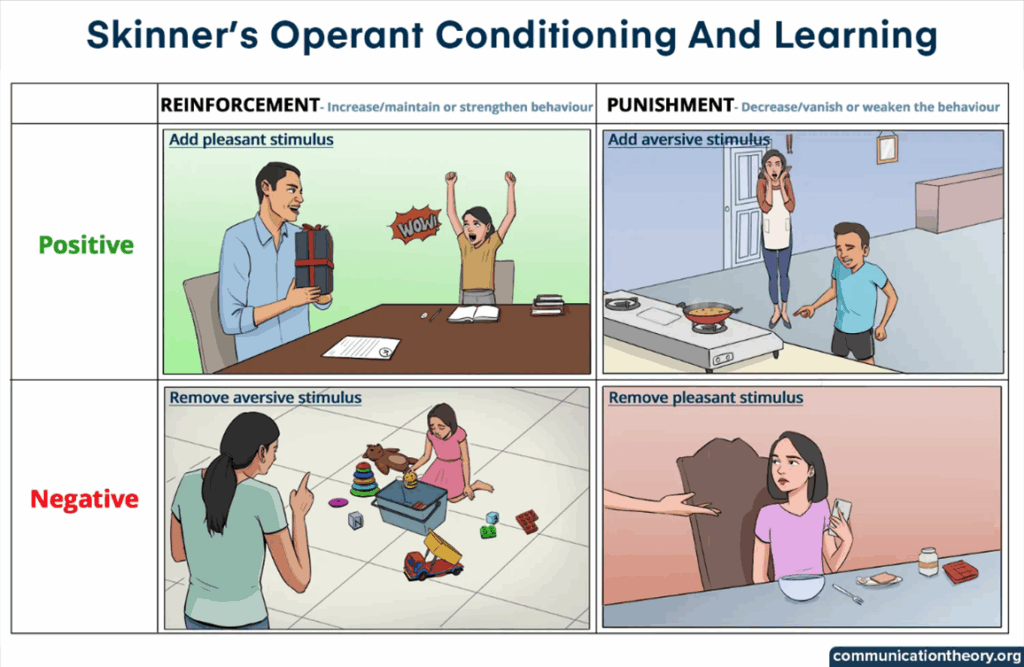
                      B.F. Skinner’s Reinforcement Theory

                      Skinner’s behaviorism theory, also known as radical behaviorism, suggests that all behavior is learned through interactions with the environment, primarily through reinforcement and punishment. This theory emphasizes observable behaviors and argues that internal mental states like thoughts are not relevant for understanding behavior. Skinner’s work focused on challenging conditioning, where behaviors are modified by their consequences. It is built on the assumption that behaviour is influenced by its consequences. Reinforcement theory is the process of shaping behavior by controlling consequences of the behavior. Reinforcement theory proposes that you can change someone’s behaviour by using reinforcement, punishment, and elimination. I give here example of Abraham Lincoln who was the president of the United States in a pivotal moment during the Civil War. Although he was assassinated before completing his term as president, the relentless work ethic and unmatched communication skills that Abraham Lincoln showcased while healing the fractured country made him one of the greatest leaders in U.S. history.
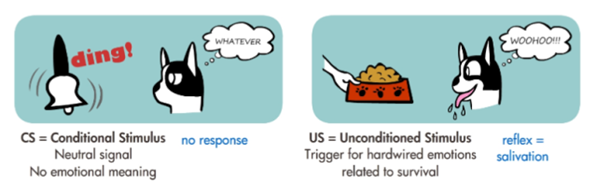
                      Pavlov’s theory of Classical Conditioning

                      This is rooted in the idea that behavior is the result of conditioning. He believed that behavior is learned through the process of classical conditioning, where behavior is shaped through the association of stimuli in the environment. His discoveries provided a framework for understanding how behaviors are acquired. His experiments primarily involved dogs, but the principles he discovered have far-reaching implications for understanding human behaviour as well. Classical conditioning, the foundation of Pavlov’s theory, involves pairing a neutral stimulus with an unconditioned stimulus to elicit a conditioned response. In one of his famous experiments, Pavlov observed that dogs naturally salivated when presented with food, an unconditioned stimulus. However, through repeated pairings of a neutral stimulus, such as a bell, with the food, the dogs eventually began to associate the bell with the arrival of food. As a result, they started salivating at the sound of the bell alone, even in the absence of the food. This conditioned response demonstrated the formation of a new association between the neutral stimulus and the unconditioned stimulus. Mental conditioning is a process which depends on experience, it takes efforts of training your mind to modify your thoughts, attitudes, and beliefs to accept thinking patterns.
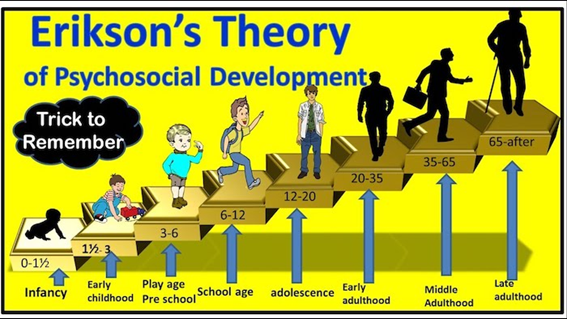
                      Erikson’s theory of psychosocial development

                      This theory proposes that behaviourism develops through eight stages, each marked by a unique milestone, crisis or challenge that individuals must manage through. These crises involve a struggle between opposing forces, such as trust vs. mistrust, autonomy vs. shame and doubt, initiative vs Guilt, Industry vs inferiority , identity vs Role Confusion, intimacy vs Isolation, Generativity vs Stagnation and Ego Integrity vs Despair. When individuals successfully resolve each crisis, it leads to the development of specific virtues and psychological strengths, while failure can result in difficulties in future stages Our early life experience is very important in terms of  how we grow as individuals.  Our identity evolves at various stages of life; how we perceive and present ourselves throughout our lives, as per our own sense of identity; we keep searching and understanding ‘who we are’. Understanding this process can lead people to question their ‘negative’ identity labelled by society. Half of life is spent in making big changes in the way we perceive ourselves.  Our personalities keep changing as we resolve crises in life; thus, each experience brings a change within us.
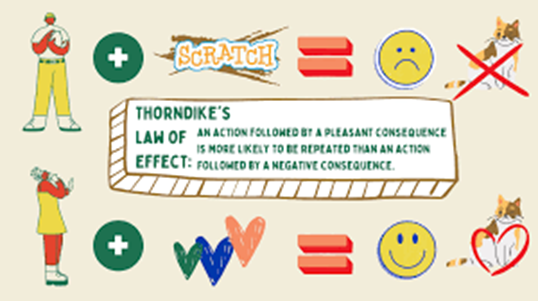
                      Thorndike’s theory of connectionism

                      This theory suggests that learning is the result of forming connections between stimuli and responses. This theory, developed by Edward Lee Thorndike, is a foundation of behaviorism, explaining learning as a “stamping in” or strengthening of S-R bonds. Thorndike’s work also established three key laws of learning: the Law of Readiness, the Law of Exercise, and the Law of Effect. Thorndike’s theory of connectionism, also known as stimulus-response (S-R) theory, suggests that learning involves forming connections or associations between stimuli and responses. These connections, or bonds, are strengthened by satisfying consequences and weakened by unsatisfying ones. Thorndike’s theory is based on his experiments with cats in puzzle boxes, where he observed that learning occurred through trial and error. The key aspects of Thorndike’s connectionism are i) learning occurs through the formation of connections between a stimulus – something that triggers a response and a response  which is a behavior or action. Ii) Learning is a process of trying different responses until the correct one is found and rewarded. Iii) Behaviors followed by satisfying moments are strengthened, while behaviors followed by annoying consequences are weakened. Iv) Frequent practice strengthens connections, while lack of practice weakens them.  V) When an individual is ready to act in a particular way, a response is likely to follow. 
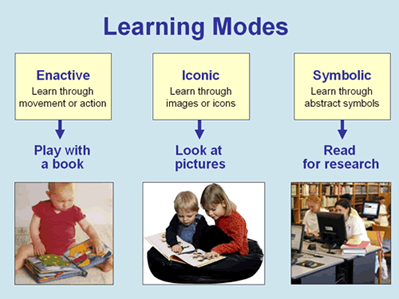
                      Jerome Bruner’s theory of cognitive development

                      This theory states that children construct their own learning through organising, categorising and then coding information. He believed that the most effective way to do this is to discover information rather than being told it by a teacher. Jerome Bruner’s theory of cognitive development emphasizes that learning occurs through three modes of representation: enactive, iconic, and symbolic. These modes represent how individuals process and represent knowledge, changing with age with mental and physical development. Bruner believed that children could learn difficult concepts with appropriate instruction, and that learning is a continuous process, not a series of stages. They say children are mirror image of their parents and surrounding. Enactive mode, prevalent in early childhood around 0-3 years, involves learning through direct action and manipulation of objects. For example, a baby might learn about size by comparing different-sized colour crayons. The iconic mode starts around 3-7 years; children begin to use images and mental representations to represent experiences. They might use drawings or pictures to recall events or objects. From about 7 years onward, children develop the ability to use symbols, like language, to represent and organize information. They can understand and use abstract concepts without needing a real visual. Bruner believed that development is a continuous process, not a series of distinct stages. 

                      Conclusion

                      In simple terms, Sigmond Freud’s theory suggests that human behavior is influenced by unconscious memories, thoughts, and urges. This theory also proposes that the psyche comprises three aspects: the id, ego, and superego. The id is entirely unconscious, while the ego operates in the conscious mind. Behaviorism is primarily associated with the belief that all behaviors are learned through interactions with the environment. It focuses on observable actions, emphasizing the role of stimuli and responses, and rejects the study of internal mental processes. Key figures in behaviorism include John B. Watson and B.F. Skinner. 

                      Tags: B.F. Skinner's Reinforcement TheoryBehaviourBehaviourismDr. Vidya HattangadiEducationegoErikson's theory of psychosocial developmentHuman resource ManagementIdJerome Bruner's theory of cognitive developmentJohn B. Watson's classical behaviourismleadershipManagementOutcomePavlov's theory of Classical ConditioningpsychologySigmond FreudStimulitheoriesThorndike’s theory of connectionism
                      Previous Post

                      Why Ganesha is called Ekdanta?

                      Next Post

                      By 2030 in the era of AI and big data some soft skills will still be prominently required  

                      Dr Vidya Hattangadi

                      Dr Vidya Hattangadi

                      Next Post
                      By 2030 in the era of AI and big data some soft skills will still be prominently required  

                      By 2030 in the era of AI and big data some soft skills will still be prominently required  

                      Please login to join discussion

                      © Copyright 2022 Dr. Vidya Hattangadi. All Rights Reserved.

                      No Result
                      View All Result
                      • Home
                      • Management
                        • Brand Management
                        • BUSINESS ETHICS
                        • Financial Management
                        • General Management
                        • Human Resources Management
                        • Information Technology Management
                        • Marketing Management
                        • Operations Management
                        • Real heros
                        • Strategic Management
                      • HIGHER EDUCATION
                      • Research
                      • News
                        • Current Affairs
                        • Political affairs
                      • GENERAL
                        • Food & Cooking
                        • Gardening
                        • Health & Wellness
                        • Heritage
                        • Leadership
                        • Literary
                        • Movies & Music
                        • People and Trends
                        • Plants and Greenery
                        • Psychology
                        • Real Heroes
                        • Spirituality & Meditation
                        • Travel & Tourism

                      © Copyright 2022 Dr. Vidya Hattangadi. All Rights Reserved.